Digital Battlefield Market Business outlook, SWOT analysis, segmentation, regional scope and forecast
The global Digital Battlefield Market is estimated at USD 32.9 billion in 2020 and is projected to reach USD 68.9 billion by 2025, at a CAGR of 15.9% from 2020 to 2025. Demand among defense forces remains high due to military upgrades as well as new procurement programs, particularly in developed and developing economies such as the US, India, and China, among others.
Some of the major factors driving this market include increasing inclination towards cloud services in military & defense, rising modernization and investments in the defense sector for developing military equipment and foreign intelligence platforms, high demand for devices supporting 5G technology for high-speed data transfer, and rapid advancement in artificial intelligence, Big Data analytics and robotics technologies.
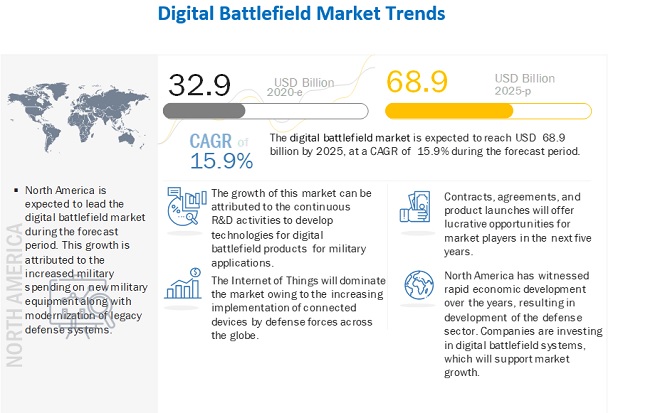
Next generation digital battlefield products are among the vital requirements of defense and intelligence agencies across countries. Hence, military and intelligence agencies are the key end users, showcasing more demand for such equipment. Some industry experts have noted that the COVID-19 pandemic has not majorly affected the demand for digital battlefield products. Companies such as Northrop Grumman Corporation (US), Lockheed Martin Corporation (US), and General Dynamics Corporation (US) received contracts for the supply of digital battlefield products to the defense forces of various countries in 2020, showcasing continuous demand during the COVID-19 crisis. Below are some important developments that showcase the increase in demand for digital battlefield in the defense sector during the COVID-19 crisis in the North American region.
Download PDF Brochure https://www.marketsandmarkets.com/pdfdownloadNew.asp?id=73234342
The COVID-19 pandemic has caused significant damage to the economic activities of countries across the world. The manufacture of digital battlefield products including systems, subsystems, and components has also been impacted. Although next generation digital battlefield products for defense applications are of prime importance, disruptions in the supply chain have halted their manufacturing processes for the time being. Resuming manufacturing activities depends on the level of COVID-19 exposure, the level at which manufacturing operations are running, and import-export regulations, among other factors.
Some important developments below showcase the increase in demand for digital battlefield in the defense sector during the COVID-19 crisis in the European region. The COVID-19 pandemic has affected deliveries of major platforms in India, such as HAL’s supply to the Indian Armed Forces of Tejas combat aircraft and Dhruv helicopters. The delivery schedules of other platforms are also likely to be pushed back, particularly if lockdowns are extended. The Indian Ministry of Defence (MoD) has extended procurement deadlines due to the COVID-19 outbreak that will in turn affect the growth of digital battlefield product which are required in such aircrafts and helicopters.
Rising modernization of military equipment to strengthen defense forces is driving the growth of the digital battlefield products in defense applications
The rising focus of defense forces across the globe on modernizing their military equipment including digital battlefield products will propel market growth. For instance, in 2020, according to International Institute for Strategic Studies (IISS), defense spending across the globe was estimated to be over USD 1,830 billion, an increase of 3.9% over 2019. This could be attributed to the growing conflicts between countries, leading to efforts to strengthen their defense forces. In recent years, over nine major international conflicts have taken place, including the Syrian Civil War, the Saudi Arabia-Yemen conflict, US-Iran tensions, and India-China tensions. Such conflicts can lead to high procurement of innovative AI-enabled battlefield products and the incorporation of advanced technologies into existing military systems to make them highly efficient and reliable.
Several governments are establishing special departments or agencies to integrate AI capabilities into the existing equipment and focus on developing new capabilities in the digital battlefield. Initiatives by such agencies, including the Strategic Council for AI Technologies (Japan), The National Science and Technology Council (US), and the AI Council (UK), will in turn support the growth of the digital battlefield market over the projected timeframe.
Based on platform, the space segment of the digital battlefield market is projected to witness the highest CAGR during the forecast period
In terms of platform, the market is segregated into airborne, land, naval and space. Based on CAGR, the space segment is projected to witness highest CAGR from 2020 to 2025. Digital battlefield systems deployed in the space platform enable real-time mapping of objects across Earth and aid in satellite communication networks. This will substantially support the space segment growth. Based on platform, the airborne segment is projected to lead the digital battlefield market from 2020 to 2025. The growth in the airborne segment is attributed to the rising inclination of defense forces towards digital battlefield products & systems.
New procurement sub segment of the digital battlefield market by installation is projected to witness the highest CAGR owing to increasing focus on defence equipment installation across the globe
Based on installation, the new procurement segment is projected to lead the digital battlefield market from 2020 to 2025. The growth in the new procurement segment is due to the rising installation of advanced defense systems and increasing procurement of next generation digital battlefield products for battle troops. The upgrades segment will register substantial growth owing to the increasing modification & modernization activities of old military electronic systems by defense forces to gain an edge over incoming threats and enemy attacks.
Regional Outlook
The North America market is projected to contribute the largest share from 2020 to 2025 in the digital battlefield market
North America is estimated to account for the largest share (41.5%) of the digital battlefield market in 2020. In the North America region, the US, with its strong defense and economic policies, is recognized as one of the key manufacturers, exporters, and users of next generation digital battlefield technologies. The new defense strategy of the US indicates an increase in military spending to include advanced capabilities in existing defense systems of the US Army to counter incoming threats. Key manufacturers and developers of AI systems in the US include Lockheed Martin Corporation (US), Northrop Grumman Corporation (US), L3Harris Technologies, Inc (US), and Raytheon Technologies Corporation(US).
The digital battlefield market is dominated by a few globally established players such as BAE Systems (UK), Northrop Grumman Corporation (US), Raytheon Technologies Corporation (US), Lockheed Martin Corporation (US), and Thales Group (US), among others.
About MarketsandMarkets™
MarketsandMarkets™ provides quantified B2B research on 30,000 high growth niche opportunities/threats which will impact 70% to 80% of worldwide companies’ revenues. Currently servicing 7500 customers worldwide including 80% of global Fortune 1000 companies as clients. Almost 75,000 top officers across eight industries worldwide approach MarketsandMarkets™ for their painpoints around revenues decisions.
Our 850 fulltime analyst and SMEs at MarketsandMarkets™ are tracking global high growth markets following the "Growth Engagement Model – GEM". The GEM aims at proactive collaboration with the clients to identify new opportunities, identify most important customers, write "Attack, avoid and defend" strategies, identify sources of incremental revenues for both the company and its competitors. MarketsandMarkets™ now coming up with 1,500 MicroQuadrants (Positioning top players across leaders, emerging companies, innovators, strategic players) annually in high growth emerging segments. MarketsandMarkets™ is determined to benefit more than 10,000 companies this year for their revenue planning and help them take their innovations/disruptions early to the market by providing them research ahead of the curve.
MarketsandMarkets’s flagship competitive intelligence and market research platform, "Knowledgestore" connects over 200,000 markets and entire value chains for deeper understanding of the unmet insights along with market sizing and forecasts of niche markets.
Contact:
Mr. Aashish Mehra
MarketsandMarkets™ INC.
630 Dundee Road
Suite 430
Northbrook, IL 60062
USA : 1-888-600-6441
Comments
Post a Comment